 URGENT DIPLOMATIC APPEAL
106 Years After the Woodrow Wilson Arbitral Award: American–Armenian Cooperation Must Unite Peace, Law, and Historical Responsibility
November 24, 2026
To: The Honorable Donald J. Trump, President of the United States of America
To: The Honorable Nikol Pashinyan, Prime Minister of the Republic of Armenia
Copies to:
The United States Secretary of State
The Legal Adviser, U.S. Department of State
The United States Senate Committee on Foreign Relations
The United States House Committee on Foreign Affairs
The National Assembly of the Republic of Armenia
Subject: Request for a Temporary Pause on Further Irreversible TRIPP Commitments, Formal Clarification of the Wilson Arbitral Award, and Congressional Examination of Atrocity Prevention in Artsakh
Dear Mr. President and Mr. Prime Minister,
I respectfully address you at a moment of exceptional historical significance for American–Armenian relations.
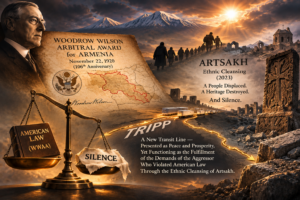
On November 22, 2026, we marked the 106th anniversary of President Woodrow Wilson’s Arbitral Award concerning Armenia.
On November 23, 2026, the United States and Armenia announced the beginning of the practical phase of the Trump Route for International Peace and Prosperity (TRIPP).
These two events, separated by 106 years, deserve to be considered together.
I welcome constructive American engagement in Armenia and sincerely appreciate the historic humanitarian generosity of the American people.
However, I believe that a new transportation and commercial initiative must not substitute for a serious examination of America’s historical legal record and contemporary humanitarian responsibilities.
I. The Unanswered Question of the Wilson Arbitral Award
On November 22, 1920, President Woodrow Wilson issued an arbitral decision concerning the frontier between Turkey and Armenia, Armenia’s access to the Black Sea, and demilitarization provisions.
This decision remains part of the official historical record.
Its present legal status, enforceability, and relationship to subsequent international agreements deserve a formal, reasoned examination.
I have previously submitted correspondence requesting clarification of its legal status and have sent repeated reminders.
I respectfully request a substantive written response.
The existence of an official historical decision should not be met with indefinite institutional silence when citizens request an explanation of its present legal meaning.
II. The American Humanitarian Legacy of Near East Relief
The Armenian people remember the extraordinary humanitarian assistance provided by the American people through Near East Relief.
American generosity helped save and sustain countless survivors of the Armenian Genocide, particularly orphaned children.
This legacy represents an enduring moral connection between the American and Armenian peoples.
I respectfully ask that it be acknowledged during the forthcoming White House meeting.
The humanitarian achievements of Near East Relief and the legal questions arising from Wilson’s Award are distinct, but both belong to the historical foundation of American–Armenian relations.
III. Armenia’s Transportation Isolation and the Principle of Reciprocity
Armenia has experienced decades of closed borders and restricted regional transportation connections.
Any new regional transportation arrangement must therefore be examined not only for its commercial potential but also for the obligations it imposes on every participating country.
I respectfully request clarification of the following:
- What enforceable commitments will Azerbaijan and Turkey undertake to provide Armenia with reciprocal transportation access?
- Will Armenian citizens, goods, and businesses enjoy equivalent rights and practical opportunities?
- What protections will prevent discriminatory restrictions or unilateral interruption of transit?
- What legal safeguards will protect Armenia’s sovereignty and jurisdiction throughout the duration of the project?
Armenia’s economic future should not depend upon commitments that cannot be independently verified or enforced.
IV. Artsakh and the Elie Wiesel Genocide and Atrocities Prevention Act
The blockade of Artsakh, Azerbaijan’s September 2023 military offensive, and the mass forced displacement of Artsakh Armenians raise serious questions about the effectiveness of international protection and American atrocity-prevention policy.
The Elie Wiesel Genocide and Atrocities Prevention Act was intended to strengthen the United States government’s ability to anticipate, prevent, and respond to mass atrocities.
I respectfully request congressional examination of what U.S. agencies knew, which preventive measures they considered, what actions they took, and why those efforts did not prevent the catastrophe.
The rights of displaced Artsakh Armenians, the situation of detainees, and the protection of Armenian religious and cultural heritage must remain subjects of international concern.
V. Armenia’s Relations with Iran and Russia
Regional connectivity should not be considered independently of Armenia’s existing relationships with Iran and Russia.
Armenia’s sovereign ability to maintain economic, diplomatic, and security relationships with its regional partners deserves careful protection.
I request a transparent assessment of TRIPP’s implications for those relationships and for regional security.
VI. Request for a Temporary Procedural Pause
In view of these unresolved questions, I respectfully request consideration of a temporary pause before further irreversible TRIPP concessions, long-term transfers of rights, or final implementing commitments are undertaken.
Such a pause would allow:
- A formal legal assessment of the present status of the Wilson Arbitral Award.
- Congressional review of U.S. atrocity-prevention decisions concerning Artsakh.
- Independent examination of TRIPP’s reciprocal obligations and safeguards for Armenian sovereignty.
- Consultation concerning Armenia’s regional security relationships.
- A written clarification that TRIPP does not, merely through its adoption, extinguish separate historical claims or legal positions.
This request does not presume that the Wilson Award automatically invalidates TRIPP.
Rather, it seeks a transparent examination of the relevant legal questions before further irreversible commitments are made.
VII. An Opportunity for American and Armenian Statesmanship
Mr. President and Mr. Prime Minister,
The forthcoming White House meeting offers an opportunity to demonstrate that contemporary diplomacy can recognize historical responsibilities while pursuing new economic cooperation.
The United States has recognized the Armenian Genocide through congressional resolutions and presidential acknowledgment.
It also possesses an extraordinary historical record of humanitarian assistance to Armenians.
These achievements deserve to be remembered alongside contemporary efforts toward peace.
I respectfully propose that the two governments establish a formal process for examining the unresolved legal questions associated with Wilson’s Award and the humanitarian questions arising from the forced displacement of Artsakh Armenians.
We are not asking America to choose between its past and its future.
We are asking America to examine its historical commitments honestly while building its future relationship with Armenia.
Peace must include sovereignty.
Connectivity must include reciprocity.
Historical recognition must be accompanied by serious consideration of unresolved legal questions.
And the rule of law must include reasoned answers from the institutions entrusted with its administration.
I respectfully request acknowledgment of this appeal, identification of the responsible offices, and a written response addressing the proposed legal review and congressional oversight.
With respect,
Dr. Vagharshak Pilossyan, M.D.
Advocate of the Woodrow Wilson Arbitral Award and Near East Relief
Founder and Chair, Council for the Restoration of the Moral Republic
Los Angeles, California, United States
November 24, 2026